Fluid state: The hidden shift behind UPI eating credit cards
Has UPI permanently disrupted credit cards?

Hi,
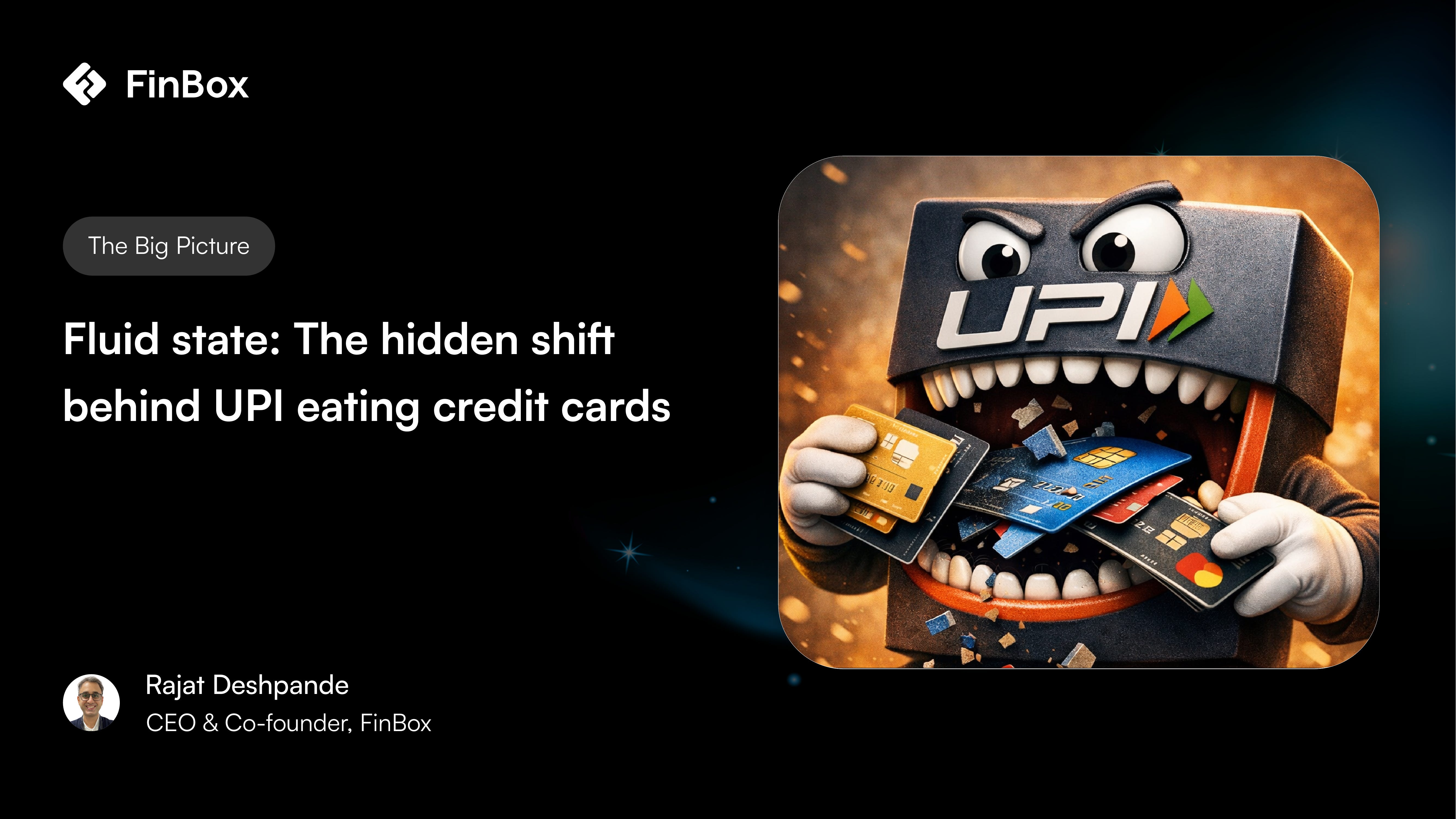
The recent conversations around BNPL vs. UPI-linked credit vs. credit cards are framed around which instrument will dominate consumer lending in India over the next decade. However, the question isn’t which credit category willcannibalize the other. Instead, it is about the structural evolution of the credit as a product and its form factor itself. We, as credit infrastructure providers, have a different view on the subject. Consumer-facing credit products should now focus on how they are discovered, experienced, and retained in a consumer’s memory instead of arbitrary market presence metrics.
I think it’s time we focus on understanding the evolution of credit behaviour rather than obsessing over its product format.
Credit historically functioned as a destination. A user entered a credit relationship through an explicit gateway, remained aware of that relationship over time, and exited through repayment or rollover. Cards exemplified this structure by creating continuity, visibility, and behavioural discipline, allowing institutions to model risk through stable and well-labelled signals.
Over the past few years, this structure has shifted toward credit appearing as a capability embedded inside everyday actions rather than as a standalone decision. The moment of borrowing now merges into the moment of consumption, and repayment compresses into short, repeatable cycles that resemble routine payments more than financial commitments.
How BNPL reshaped the meaning of borrowing
BNPL played a decisive role in this transition by reshaping the emotional framing of borrowing. Instead of asking users to adopt a credit identity, BNPL invited them to delay payment for a specific purchase, often across a brief horizon, with limited emphasis on the long-term relationship.
Market data and academic research consistently show that a significant share of BNPL users, especially younger and urban cohorts, view these transactions as extensions of checkout rather than as credit usage, which reshapes spending behaviour, repayment psychology, and expectations around credit visibility.
Once this framing settled, it began influencing how users approached other forms of borrowing, creating an environment where short-horizon credit felt natural and repeatable rather than exceptional.
Why UPI accelerated cannibalisation
UPI amplified this behavioural shift by removing friction from payments at a population scale. The repeated act of scanning and approving trained users to move money with minimal cognitive engagement, and once credit attached itself to this habit, borrowing inherited the same behavioural rhythm.
Credit lines accessed through UPI flows feel familiar, immediate, and transient, which increases frequency while reducing salience. Everyday credit moments increasingly route through BNPL and UPI-linked mechanisms, particularly in retail, travel, and digital commerce, while credit cards retain strength in higher ticket and rewards-driven use cases.
Cannibalisation emerged through redistribution of frequency rather than erosion of value, and frequency shapes behaviour more persistently.
Where credit cards feel the pressure
Credit cards continue to perform well across issuance and aggregate transaction value, yet their role within the consumer’s daily financial life has shifted. Cards require attention through dates, cycles, conditions, and optimisation decisions, which suits engaged users while creating distance for those seeking lighter interaction.
BNPL and UPI-led credit succeed by demanding minimal cognitive effort. Over time, ease becomes habit, and habit reshapes preference. Cards remain relevant, yet centrality moves elsewhere.
What institutions struggle to see
From an infrastructure perspective, the challenge lies in how these behaviours fragment risk visibility. Each rail, like BNPL, UPI-credit or credit card, generates clean and internally consistent signals, yet there is no cohesive consumer behaviour tracker that spans all of them.
A delayed BNPL repayment signals short-term stress. A stretched UPI credit line signals cash flow volatility. A card payment meeting the minimum due payment signals stress. Viewed together, these signals describe a rising reliance on short-term credit and increasing sensitivity to income disruption --- patterns that appear repeatedly across bureau data, market studies, and lender portfolios.
Institutions organised around product silos struggle to assemble this composite picture. Teams optimise individual funnels and loss curves, while the user moves fluidly across instruments. Cannibalisation, therefore, manifests less as revenue movement and more as interpretive loss.
What does that mean? Well, cannibalisation here refers less to money shifting between products and more to understanding money breaking apart across them. As borrowers spread their credit usage across BNPL, UPI-linked credit, and cards, each system continues to show healthy signals in isolation, while the combined risk becomes harder to read. Brief repayment delays, stretched credit lines, and minimum repayments appear manageable when viewed separately, yet together they indicate rising dependence on short-term credit. Revenue continues to flow, though risk visibility weakens; early warning arrives later, and confidence in decision-making erodes. The real loss surfaces in interpretation long before it appears in defaults.
Why regulation followed behaviour
Regulatory actions in recent years reflect recognition of this shift. Clarifications around BNPL structures, formalisation of credit lines on UPI, and tighter definitions around prepaid instruments aim to restore legibility to credit flows while preserving the convenience and value for users.
Oversight follows behaviour, and behaviour has already embraced embedded borrowing, which places greater emphasis on visibility, accountability, and coherence across credit journeys.
What this means for the credit infrastructure
This environment reshapes the role of credit infrastructure fundamentally. Product-centric intelligence loses power as borrowing disperses across moments. Behaviour-centric intelligence gains importance as continuity replaces categories as the primary unit of understanding.
Systems capable of stitching signals across rails, recognising early stress patterns, and contextualising repayment behaviour gain a structural advantage over systems optimised for isolated instruments. Early warning, behavioural coherence, and consent-led visibility grow more valuable than static scores or single-rail histories.
The Big Picture
The BNPL versus UPI versus credit card debate serves as a surface indicator of a deeper transition. Credit has moved away from categories and toward capabilities embedded inside everyday behaviour.
For infrastructure builders, the opportunity lies in helping lenders understand how credit behaves once it becomes ambient, frequent, and lightly held in memory. The future belongs to systems that interpret people rather than defend products, and that translate fragmented behaviour into coherent insight.
Credit already escaped its traditional containers. Infrastructure now carries the responsibility of catching up.
Until next time,
Rajat Deshpande